Choosing the right platform is one of the most important decisions when building a business website or online store. WordPress and Shopify are two of the most popular options, but they are designed with different priorities.
Shopify is primarily an ecommerce platform that provides hosting, store management, payments, themes, and ecommerce functionality in one ecosystem.
WordPress is a flexible content management system that can be used for business websites, blogs, ecommerce stores, membership websites, marketplaces, and custom digital experiences. With WooCommerce, WordPress can also become a powerful ecommerce platform.
So, which is better: WordPress or Shopify?
The answer depends on your business goals, but businesses that need greater customization, content flexibility, SEO control, and ownership often find WordPress more suitable.
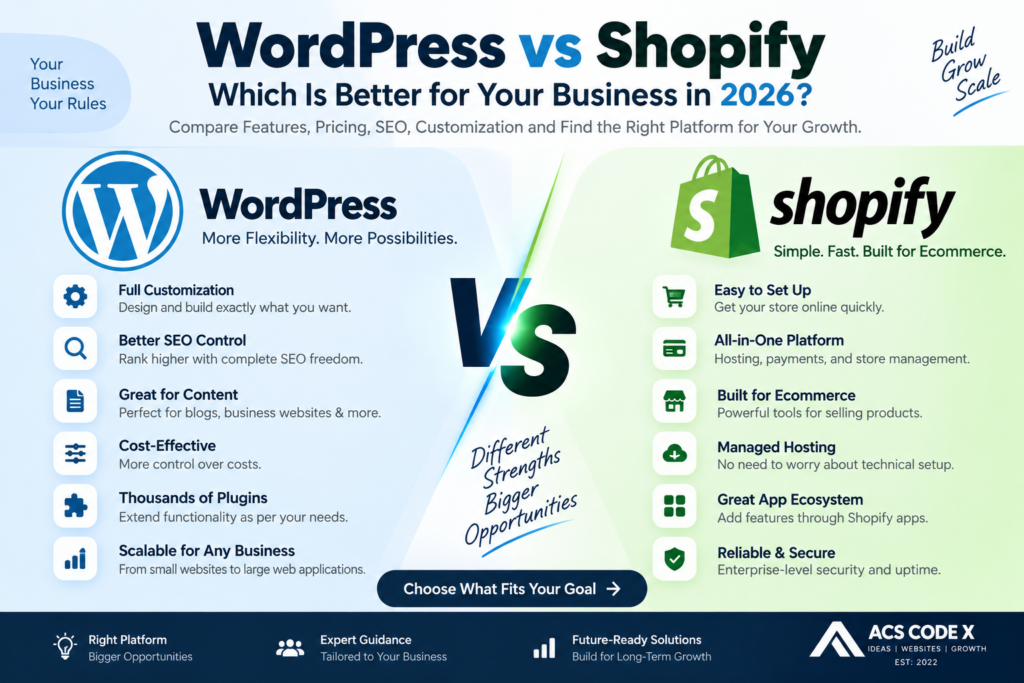
WordPress vs Shopify: Quick Comparison
| Feature | WordPress | Shopify |
|---|---|---|
| Customization | ⭐⭐⭐⭐⭐ | ⭐⭐⭐⭐ |
| SEO flexibility | ⭐⭐⭐⭐⭐ | ⭐⭐⭐⭐ |
| Ecommerce | ⭐⭐⭐⭐⭐ with WooCommerce | ⭐⭐⭐⭐⭐ |
| Content/blogging | ⭐⭐⭐⭐⭐ | ⭐⭐⭐ |
| Design flexibility | ⭐⭐⭐⭐⭐ | ⭐⭐⭐⭐ |
| Hosting control | More flexibility | Managed |
| Plugin ecosystem | Extensive | Extensive app ecosystem |
| Custom functionality | Highly flexible | More platform-dependent |
| Scalability | Highly flexible | Highly scalable |
| Ease of setup | Moderate | Easy |
1. WordPress Offers More Customization
One of the biggest advantages of WordPress is flexibility.
With WordPress, developers can modify the website’s design, functionality, database structure, integrations, and backend according to specific business requirements.
You can create:
- Corporate websites
- Ecommerce stores
- Membership platforms
- Booking websites
- Learning platforms
- Marketplaces
- Blogs
- Custom web applications
Shopify is excellent for ecommerce, but businesses may encounter more platform-specific limitations when they need highly customized functionality.
2. WordPress Gives You More SEO Control
SEO is another major reason businesses choose WordPress.
WordPress allows developers and SEO specialists to control many aspects of a website, including:
- URL structure
- Metadata
- Internal linking
- Schema markup
- XML sitemaps
- Robots directives
- Canonical URLs
- Content structure
- Technical SEO
- Performance optimization
Shopify also supports SEO, but WordPress generally provides greater flexibility for businesses that want deep technical and content-level control.
For businesses investing heavily in organic search, this flexibility can be valuable.
3. WordPress Is Excellent for Content Marketing
If your strategy depends heavily on blogging, educational content, guides, landing pages, and topical authority, WordPress has a major advantage.
You can build detailed content structures around your target topics and connect them through internal links.
For example, an SEO agency could create:
SEO Services
→ Technical SEO
→ Local SEO
→ AI SEO
→ Ecommerce SEO
→ SEO for Small Businesses
→ SEO Guides
This makes WordPress particularly attractive for businesses using SEO + content marketing as a long-term growth strategy.
4. WordPress Can Be More Flexible With Ecommerce
WordPress itself isn’t primarily an ecommerce platform, but WooCommerce can transform it into a complete online store.
You can customize:
- Product pages
- Checkout
- Payment gateways
- Shipping
- Product variations
- Customer accounts
- Discounts
- Taxes
- Order management
- Custom integrations
For businesses with unique ecommerce requirements, this flexibility can be a major advantage.
Shopify, on the other hand, provides a more standardized ecommerce experience that can be easier to launch and manage.
5. WordPress Gives You More Design Freedom
With WordPress, you aren’t restricted to a single design system.
Developers can create completely custom layouts and experiences using:
- Custom themes
- Page builders
- Block editor
- Custom CSS
- JavaScript
- PHP
- Custom plugins
This is particularly useful for businesses that want their website to look different from competitors.
6. WordPress Is Better for Businesses That Need Multiple Website Functions
Imagine a company needs:
Website + Blog + Ecommerce + Booking + Membership + Lead Generation
WordPress can bring these requirements together through plugins, integrations, and custom development.
Shopify is extremely strong when ecommerce is the primary purpose of the website.
But if ecommerce is only one part of a larger digital ecosystem, WordPress may provide more flexibility.
7. What About Shopify?
Shopify isn’t a bad choice.
In fact, Shopify can be an excellent option for businesses that want to launch an ecommerce store quickly without managing many technical aspects themselves.
Shopify is particularly attractive when you want:
- Quick store setup
- Managed hosting
- Built-in ecommerce functionality
- Simple product management
- Easy payment integration
- Professional ecommerce themes
- Less technical maintenance
For a straightforward online store, Shopify can be easier to manage than WordPress + WooCommerce.
WordPress vs Shopify for SEO
If SEO is one of your primary growth channels, WordPress can be particularly attractive because it provides extensive control over content and technical optimization.
However, the platform alone does not determine rankings.
A poorly optimized WordPress website can perform worse than a well-optimized Shopify website.
Your SEO results still depend on:
Technical SEO + content quality + search intent + authority + internal linking + user experience + backlinks.
WordPress vs Shopify Pricing
Pricing depends heavily on the type of website you build.
With WordPress, costs can include:
- Hosting
- Domain
- Premium themes
- Plugins
- Development
- Maintenance
- Security
Shopify generally follows a subscription-based model, with additional costs potentially coming from apps, themes, payment processing, and other services.
Therefore, don’t compare platforms only by their monthly subscription price.
Instead, compare the total cost of ownership based on your actual business requirements.
WordPress vs Shopify: Which Is Better?
Choose WordPress if you need:
- Maximum customization
- Advanced SEO control
- Content-heavy website
- Custom functionality
- WooCommerce ecommerce
- Membership features
- Complex integrations
- Full design flexibility
- Long-term content marketing
Choose Shopify if you need:
- Quick ecommerce setup
- Managed hosting
- Simple store management
- Less technical maintenance
- A primarily ecommerce-focused website
- A standardized online store environment
Final Verdict
So, is WordPress better than Shopify?
For businesses that prioritize customization, SEO flexibility, content marketing, and complete control over their website, WordPress can be the better choice.
For businesses that primarily want to launch and manage an ecommerce store quickly, Shopify can be an excellent solution.
At ACS Code X, we help businesses choose and build the right platform based on their business model, growth goals, SEO strategy, and technical requirements.
Whether you need a custom WordPress website, WooCommerce store, Shopify store, or a complete SEO-ready business website, the right platform should be selected based on your long-term goals—not simply what’s popular.
FAQs
Is WordPress better than Shopify?
WordPress can be better for businesses that need customization, SEO control, content marketing, and complex functionality. Shopify can be better for businesses that primarily need a simple, managed ecommerce platform.
Is WordPress cheaper than Shopify?
It depends on your requirements. WordPress has flexible hosting and development options, while Shopify uses subscription-based pricing and may involve additional app and transaction costs.
Which is better for SEO, WordPress or Shopify?
WordPress generally provides more SEO customization and technical control, but both platforms can rank well when properly optimized.
Which is better for ecommerce, WordPress or Shopify?
Shopify is easier for launching a standard ecommerce store, while WordPress with WooCommerce offers greater customization for businesses with specific requirements.
Can WordPress replace Shopify?
Yes. WordPress with WooCommerce can provide most of the functionality needed to operate an ecommerce store, with additional flexibility for customization and content.
Should a small business use WordPress or Shopify?
A small business should choose based on its goals. WordPress is often suitable when SEO, content, customization, and broader website functionality are important. Shopify is attractive when ecommerce simplicity is the priority.